You found a webtoon you love, but it only updates in Korean. Or a Chinese manhua that English fan-translation never caught up to. The story is right there — the only thing standing between you and the next chapter is the language.
Machine-translating a webtoon isn't the same as translating a page of text. Webtoons are long vertical strips, drawn in full color, with dialogue stuffed inside speech bubbles and sound effects hand-lettered right onto the artwork. Drop a screenshot into a generic translator and you get garbled OCR, broken panels, and erased art.
This guide shows how to translate a webtoon, manhwa, or manhua to English properly — what makes it hard, how AI handles it end to end, and how to do it for free with Belin Doc's Webtoon Translator.
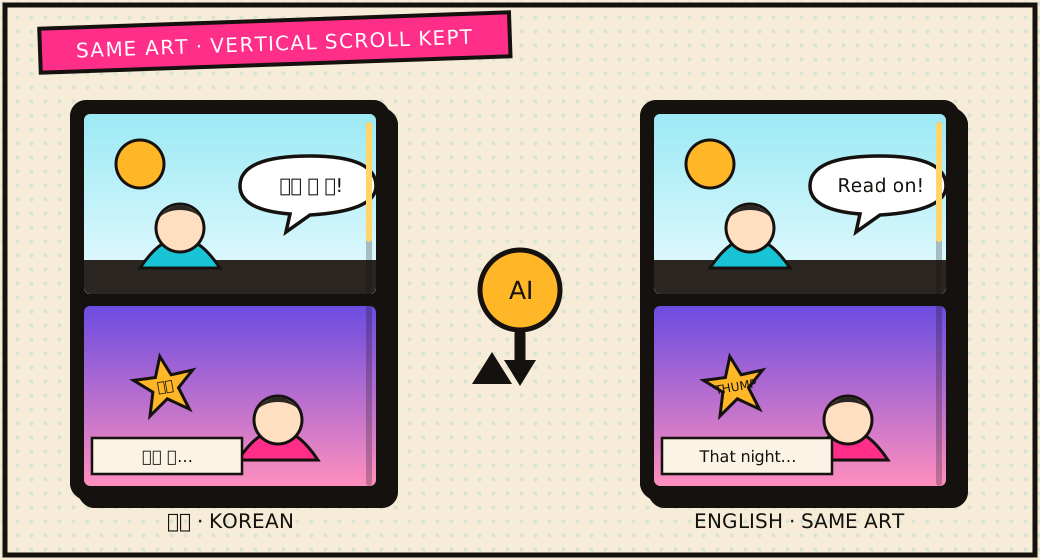
Quick answer: To translate a Korean or Chinese webtoon to English, upload the image or PDF to Belin Doc's Webtoon Translator, choose Korean → English or Chinese → English, and download. The AI detects speech bubbles and on-panel sound effects, runs comic-tuned OCR, translates with full-scene context, erases the original lettering with AI inpainting, and re-renders the English text — keeping the vertical-scroll layout and full color intact. Free, no signup.
This guide covers:
👉 Why webtoons are harder to translate than manga or documents 👉 How AI webtoon translation works, step by step 👉 How to translate Korean and Chinese webtoons to English for free
Webtoon vs. Manga: Why the Difference Matters
Webtoons have grown into a major global format — the worldwide webtoons market was valued at USD 11.8 billion in 2025 and is projected to reach USD 101.8 billion by 2034, a 26.26% CAGR, according to IMARC Group. As more readers follow series across languages, a clean translation matters more than ever — and that starts with understanding the format.
People use "webtoon," "manhwa," "manhua," and "manga" loosely, but for translation they behave very differently:
- Webtoon / manhwa (Korean) — born digital, designed as one long vertical scroll read top to bottom, almost always in full color.
- Manhua (Chinese) — similar vertical-scroll, full-color web format; source text is Simplified or Traditional Chinese.
- Manga (Japanese) — traditionally page-based, black-and-white, and frequently uses vertical text right-to-left.
That means a translator built only for Japanese manga will mishandle a webtoon: it may split a continuous strip into wrong "pages," lose color fidelity, or fail on the layout. A proper webtoon translator has to treat the long-strip, full-color format as a first-class case.
If your source is specifically Japanese page-based comics, see our companion guide on AI manga translation.
Why Translating a Webtoon Is So Much Harder Than Translating Text
First-timers usually screenshot a panel and paste it into a generic OCR translator — and quickly hit a wall:
- ❌ Garbled bubble text — stylized fonts, mixed Korean/Chinese, and handwritten lettering wreck plain OCR.
- ❌ Sound effects baked into the art — on-panel SFX and signage aren't neatly boxed; they're drawn into the scene.
- ❌ Broken vertical scroll — long strips get chopped into wrong segments, shifting or duplicating panels.
- ❌ Lost context — translating bubble-by-bubble destroys character voice, honorifics, and the flow of a conversation.
- ❌ Destroyed artwork — after translating you still have to erase the original text and repaint the background by hand.
A single manually translated episode can take hours. AI webtoon translation exists to absorb all of these steps into one automated pipeline.
How AI Webtoon Translation Works, Step by Step
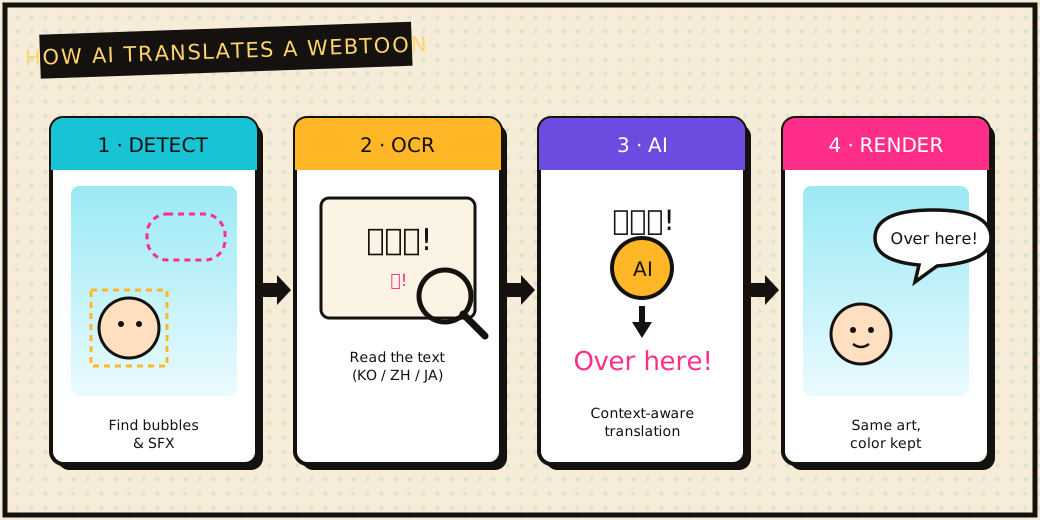
Belin Doc doesn't just "screenshot and translate" — it runs a full multi-stage pipeline tuned for comics:
Step 1: Bubble & Text Detection
After you upload a webtoon image or PDF, the system locates every text region — oval speech bubbles, rectangular narration boxes, irregular hand-drawn bubbles, and loose on-panel sound effects. This uses detection models trained on comic scenes, which handle stylized lettering more reliably than general-purpose OCR.
Step 2: OCR Text Extraction
Each region is read with OCR tuned for comics, supporting Korean, Chinese (Simplified and Traditional), Japanese, and English — including vertical layouts and stylized lettering.
Step 3: Context-Aware AI Translation
Extracted text is translated with the surrounding dialogue as context, not line by line. That keeps character voice consistent, preserves honorifics and slang, and stops names or terms from drifting mid-scene. Belin Doc supports multiple engines including ChatGPT, Claude, Gemini, and DeepSeek.
Step 4: Original Text Removal
The original lettering inside bubbles is erased with AI inpainting — a computer-vision technique for reconstructing missing or removed regions of an image from the surrounding content (Elharrouss et al., Image Inpainting: A Review). Here it rebuilds the background — screentone, flat color, or gradient — so no manual masking in Photoshop is needed.
Step 5: Translated Text Rendering
Finally the English text is rendered back into the original bubbles. Font size and line spacing are fitted automatically to avoid overflow, and the vertical-scroll layout, panels, and full color stay exactly as drawn.
The output is a finished, ready-to-read translated webtoon — no post-processing required.
How to Translate a Webtoon to English for Free
Even your first time, the flow is three steps:
Step 1: Upload
Open the Webtoon Translator and drop in your webtoon image, screenshot, or PDF — JPG, PNG, WEBP, and multi-page files all work, including long vertical-strip episodes. Scanned or screenshotted pages are handled with OCR automatically.
Step 2: Pick a Language
Choose your direction — Korean → English, Chinese → English, Japanese → English, and 100+ languages in both directions are supported.
Step 3: Download
The pipeline runs bubble detection → OCR → translation → text removal → rendering with no manual steps, and you download the finished episode with the original art intact.
Korean and Chinese to English: What to Watch For
Most webtoons originate in Korean or Chinese — on platforms like Naver, Kakao, WEBTOON, Tapas, and Bilibili Comics — and each language has quirks that a good translator handles:
- Korean honorifics — speech levels (반말 vs. 존댓말) carry relationship and tone. Context-aware translation preserves that register instead of flattening everyone to the same voice.
- Chinese cultivation / xianxia terms — manhua leans on genre vocabulary (sects, realms, technique names). Full-page context keeps these terms stable across panels.
- Onomatopoeia & SFX — Korean and Chinese sound effects rarely map one-to-one to English; AI renders a natural English equivalent rather than a literal transliteration.
For a deeper look at handling stacked or vertical lettering, see translating vertical text. When quality matters most, you can also pick a stronger model on the AI Models page.
Belin Doc vs. Traditional Webtoon Translation
| Comparison | Belin Doc AI | Manual Scanlation | Screenshot + Translator |
|---|---|---|---|
| Speed | Seconds per page | Hours per episode | 5–10 min/page |
| Bubble + SFX detection | ✔️ Automatic | Manual | ❌ |
| Text erasure | ✔️ AI inpainting | Manual Photoshop | ❌ |
| Vertical-scroll aware | ✔️ Long-strip native | ✔️ Human | ❌ Breaks panels |
| Color preserved | ✔️ Untouched | ✔️ | ❌ |
| Context understanding | ✔️ Full-page | ✔️ Human | ❌ Line by line |
| Cost | Free monthly pages | High effort | Low quality |
In one sentence: Belin Doc doesn't help you translate a webtoon — it translates the whole episode for you, art and all.
❓ FAQ
Can I translate a Korean webtoon to English?
Yes. Upload the webtoon image or PDF, choose English as the target, and the AI translates the Korean dialogue and sound effects while keeping the vertical-scroll layout and full color intact.
Does it work for manhwa and manhua too?
Yes. The translator is tuned for Korean manhwa and Chinese manhua as well as Japanese-style comics, handling speech bubbles and on-panel text in each.
How accurate is AI webtoon translation compared with human scanlation?
It's built for fast, readable results rather than to replace a polished human edit. Context-aware translation keeps character voice, honorifics, and terminology consistent across panels, so you can read the next chapter today — for a public release, treat AI as the first pass and review the tricky panels.
Can I translate a full ongoing series or batch of chapters?
Yes. The translator handles multi-page chapters and long vertical-strip episodes, so you can process whole chapters at a time instead of one panel per screenshot.
Is it legal to translate a webtoon?
Translate only raws you have the right to use — for example, your own work, official sources, or content you are authorized to localize. AI translation is a tool; respecting the original creator's copyright is on you.
Will the original art change?
No. Only the text inside bubbles and the SFX lettering are replaced. Line art, screentone, and full color are preserved exactly.
What files can I upload?
Webtoon screenshots and images (JPG, PNG, WEBP) and PDFs, including long vertical-strip episodes and multi-page chapters.
Is AI webtoon translation really free?
Yes. There are free pages with no signup required, and OCR for scans and screenshots is included at no extra step.
Which languages are supported?
Korean, Chinese, English, Japanese and 100+ languages in both directions, so you can translate webtoons to and from most major languages.
Where AI Webtoon Translation Still Struggles
AI absorbs the heavy lifting, but a few cases still benefit from a human pass:
- Hand-drawn artistic SFX — sound effects fused into the artwork at extreme angles or styles can be harder to detect and repaint cleanly.
- Heavy wordplay and dialect — puns, regional slang, and culture-bound jokes sometimes need a human touch to land naturally.
- Dense or overlapping bubbles — very tight lettering in small bubbles can require manual size tuning.
For casual reading these rarely get in the way. For a polished public release, treat AI as the first pass and review the tricky panels.
Final Thoughts
The point of AI webtoon translation isn't to replace a polished scanlation — it's to read the next chapter today instead of waiting weeks, with the art untouched.
If you're following an ongoing Korean webtoon, a Chinese manhua, or running cross-border comic content, Belin Doc's Webtoon Translator is free to try and needs no signup.