Note: This review was completed on December 16, 2025. It shows how GPT-5.2 performed at that time and does not mean it is still our first recommendation. To see how newer models perform, read our GPT-5.6 document translation review and DeepSeek V4 translation review.
Foreword: Calm Analysis Amidst the Hype
The most discussed topic in the tech world recently is undoubtedly the release of GPT-5.2. As practitioners in the document translation field, we have received a large number of user inquiries: Is GPT-5.2 really as magical as the legends say? Can it optimize and solve the many pain points in PDF translation?
To answer this question, we immediately integrated GPT-5.2 into our site's test environment. We didn't rush to approve it but spent a few days conducting a deep horizontal comparison review.
In this article, we will strip away the marketing filters and objectively demonstrate the real performance of GPT-5.2 when dealing with complex documents like PDFs and PPTs, as well as its pros and cons compared to DeepL and the older GPT-4o.
Technical Analysis: What Does GPT-5.2 Mean for Translation?
Before looking at the actual tests, we need to understand two key features brought by GPT-5.2, which theoretically target the weak points of translation scenarios:
- Stronger Layout Perception: Official claims state that GPT-5.2 can better understand "visual structure." Theoretically, this means that when translating PDFs, it should be able to distinguish between body text and sidebar notes, thereby reducing formatting errors.
- Introduction of Thinking Mode: Unlike the "word-for-word" response of the past, the new mode inherits the GPT-5.1 series' ability to perform short "logical reasoning" before outputting. This helps with contextual consistency when dealing with legal clauses and long academic sentences, but it may also slow down response times.
Testing Ground: Real-World Performance Review
We selected three high-frequency but error-prone document scenarios to compare the performance of GPT-5.2 and GPT-4o.
Testing Ground: Powerful Combination vs. Traditional Solutions
We selected the three real-world document scenarios where users most easily "fail" and compared the performance of [Our Self-Developed Parsing Engine + GPT-5.2] vs. [Traditional Translation Tools].
Scenario 1: PDF Translation with Complex Nested Tables
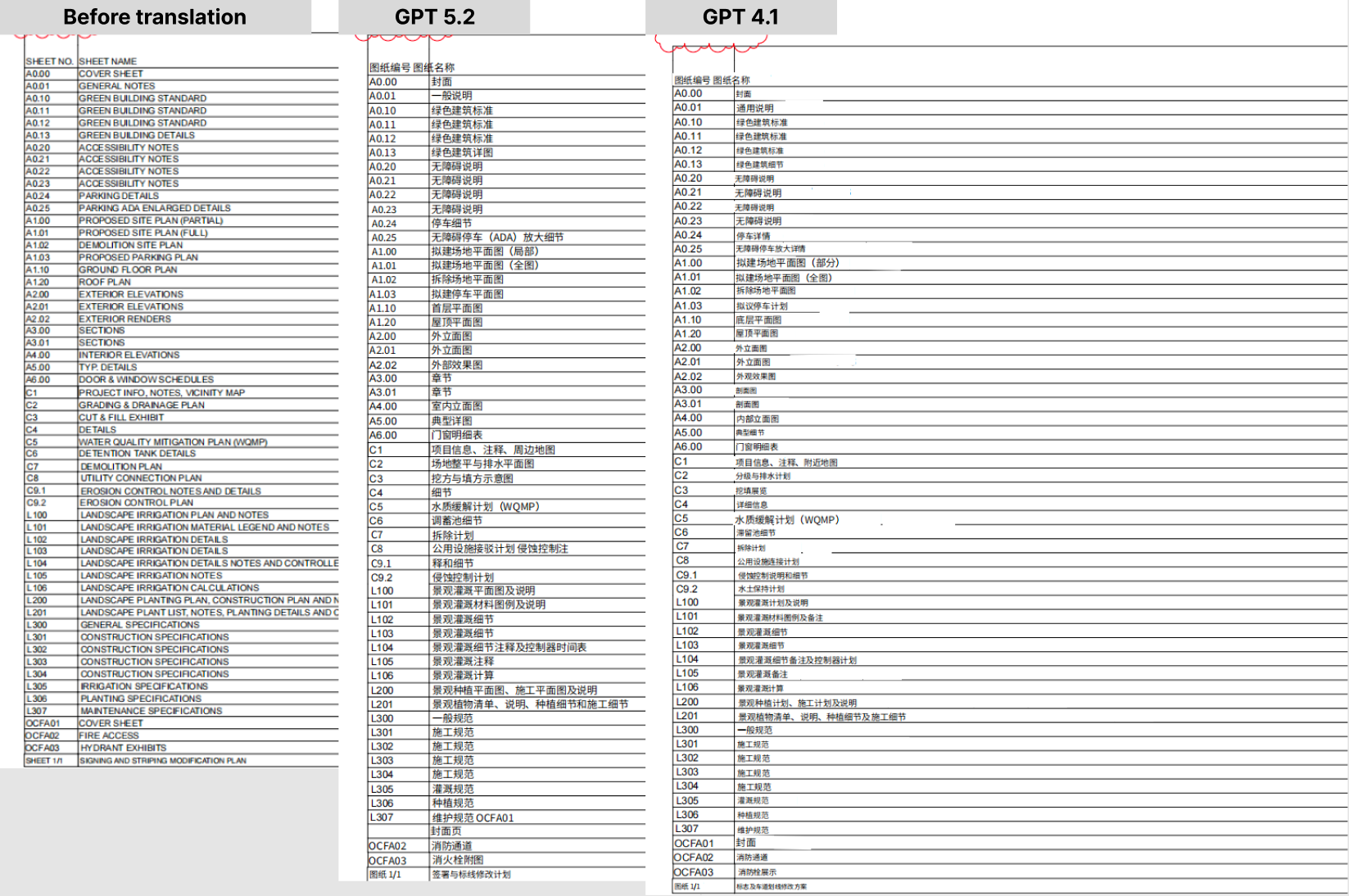
- Test Difficulty: Multi-layer merged cells, hidden borders, cross-page long tables. This is a "nightmare" for format parsing.
- Traditional Solution Pain Points: Traditional machine translation often focuses only on text and ignores structure. The result is often: cell content misalignment, data originally in the third column running to the second column, or the translation becoming too long and exploding the table, causing all subsequent pages to be disordered.
- Our Parsing + GPT-5.2 Review:
- Layout Performance (Our Algorithm): Our parsing engine played a decisive role here. It accurately identified the nested structure, locking each cell as an independent "container" to ensure 1:1 structure restoration.
- Translation Performance (GPT-5.2): GPT-5.2's cleverness lies in its "restraint." In compact tables, it automatically chooses more concise vocabulary to fit the cell width, rather than outputting a long paragraph of explanatory text like older models.
- 👉 Conclusion: In the Belin Doc document translation test, GPT-5.2 performed excellently in processing complex tables.
Scenario 2: Technical Documents with Professional Terminology
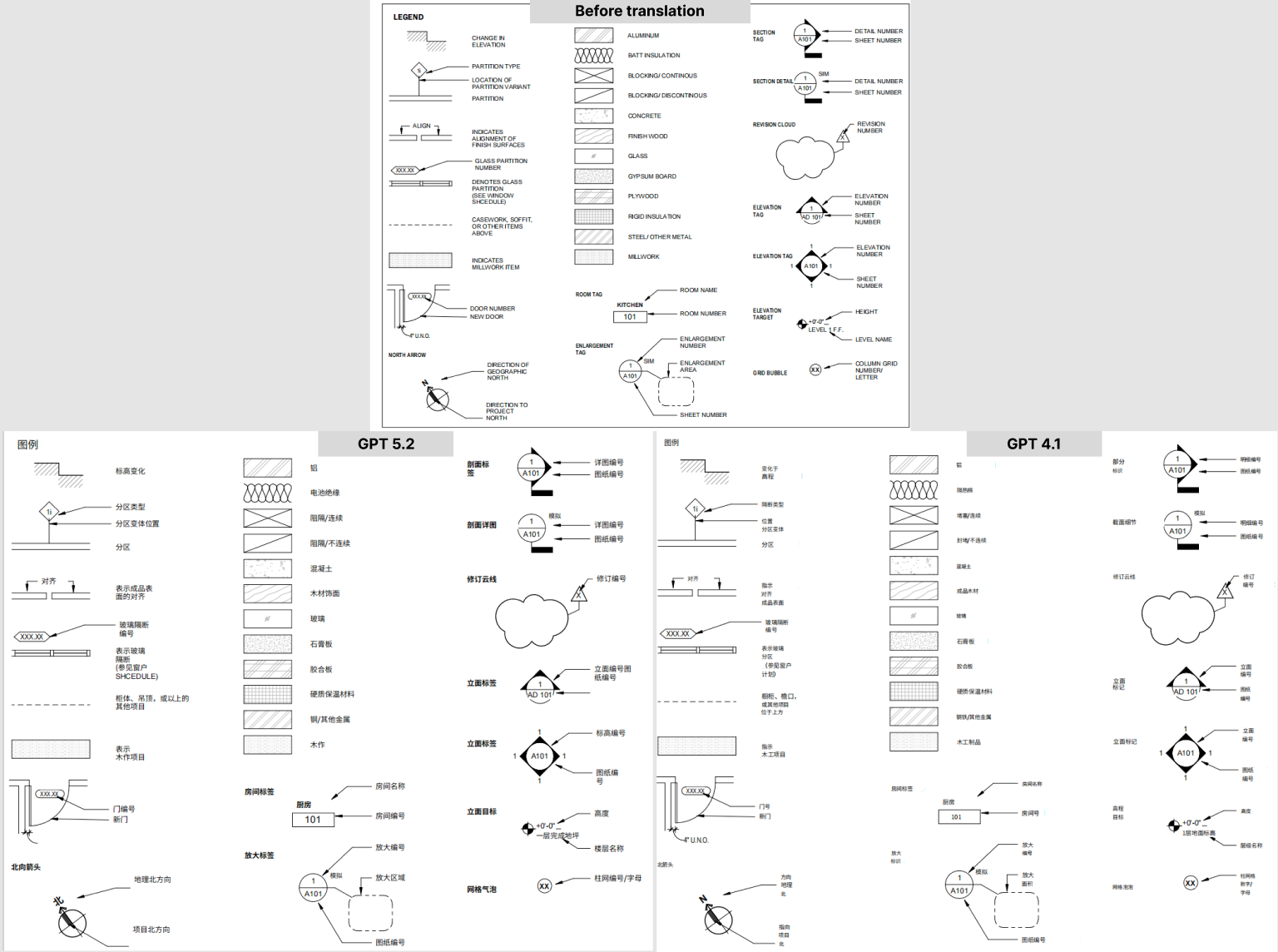
- Test Difficulty: Industry jargon, acronyms, polysemy. Requires extremely high domain knowledge.
- Original Case: "Driver" and "Bus" appeared in a computer engineering document.
- Ordinary Machine Translation: Easily literally translated as "Chauffeur" and "Public Bus" (in Chinese), turning the entire technical document into a joke.
- Our Parsing + GPT-5.2 Review:
- Terminology Accuracy: GPT-5.2's Thinking Mode showed its power here. By analyzing the full context, it quickly determined that this is the "IT field," thus accurately translating "Driver" as "Device Driver" (驱动程序) and "Bus" as "Data Bus" (总线).
- Consistency: For documents spanning dozens of pages, it maintains core terminology consistency throughout, avoiding low-level errors like calling it "Client" on page 1 and "Customer Machine" on page 10.
- 👉 Conclusion: It's equivalent to equipping your document with an industry expert with 10 years of experience for proofreading.
Scenario 3: Lifestyle/Consulting EPUB Translation
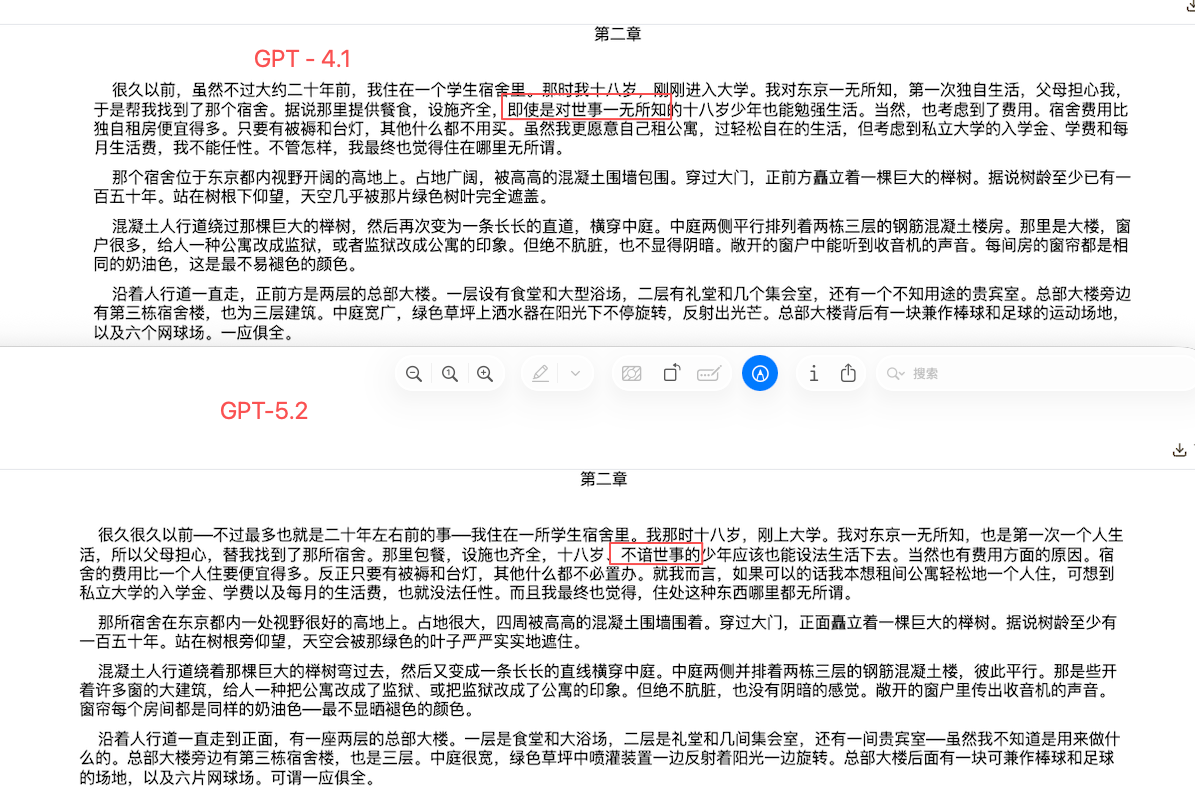
- Test Difficulty: Tone management. Consulting reports, travel guides, or psychological counseling documents need "warmth" and "empathy," not a cold instruction manual style.
- Original Case: Norwegian Wood - Haruki Murakami
- GPT-4o: "As long as there is bedding and a lamp, nothing else needs to be bought. Although I would prefer to rent an apartment myself and live a relaxed life." (Accurate but stiff, like a robot speaking).
- Our Parsing + GPT-5.2 Review:
- Tone Adjustment: GPT-5.2 understood that this is a literary work, so it adopted a softer tone.
- Cultural Polishing: When dealing with lifestyle documents, it even automatically converts "ounces/miles" to "grams/kilometers," which is more intuitive for Chinese readers.
- 👉 Conclusion: Say goodbye to "machine translation flavor"; it outputs warm and touching text.
Conclusion: Is GPT-5.2 Right for Everyone?
After multiple rounds of testing, we give an objective profile of GPT-5.2's translation capabilities:
✅ Its Strengths:
- Qualitative Leap in Understanding: Especially good at handling "soft translation" that requires context (such as marketing, literature, colloquialisms).
- Format Friendly: In terms of PDF and PPT layout restoration, there is a visible improvement compared to previous models.
- Long Text Logic: Suitable for translating entire e-books or papers.
⚠️ Its Limitations:
- Speed and Cost: If you pursue second-level translation and have low context requirements (such as simple hotel confirmation slips), the Gemini 2.5 series or other translation models may be more cost-effective.
- Risk of "Overacting": In Thinking Mode, it occasionally over-optimizes the original text. If you are a legal or medical industry user, it is recommended to use it in conjunction with our "Precision Mode" setting.
Conclusion: GPT-5.2 is not magic, but it is indeed one of the best solutions currently available for processing high-context documents.
🔗 Related Reading: How to Improve AI Translation Results?
Tools are just aids; using them well requires skill. To make up for AI's shortcomings, it is recommended to read the following articles in conjunction:
- [Model Review] 🆕 GPT-5.6 Document Translation Review: Sol vs Terra vs Luna
- [Model Review] 📊 DeepSeek V4 Document Translation Review: vs V3.2, GPT-5.4, Claude 4.7 & Gemini 3 Pro
- [Model Review] 📄 Gemini VS GPT Document Translation Scenario Review
- [Model Review] 💡 Gemini 3 Pro Document Translation Scenario Review
- [Model Review] 💡 Engineering Drawing Document Translation Scenario Review
Want to test GPT-5.2 yourself?
We have integrated the latest GPT-5.2 interface on our website and optimized it for document parsing. Whether it is an academic paper or a business report, you can upload it and try it out to see if it meets your expectations.